
THE DIRECTOR
Bangkok, Thailand. A bench by the river. Two people who had no reason to meet, and every reason to matter to each other.
Hawaiian-Filipino filmmaker. Bangkok, present day.
Larry Cortez spent thirty years making films in Hawaii. He was the kind of director who lay perfectly still on a beach at golden hour, waiting for the exact moment a shaft of light broke over the ocean and threw a sailboat mast into pure silhouette — holding the shot until the light and the shadow aligned into something that could not be planned, only waited for. Who pushed his AD's umbrella away in a downpour because if the actors were in it, he was in it. Who found the precise cut point — two frames back — where grief becomes acceptance. He made audiences weep without knowing why. That was his life's work. He lived entirely through his eyes.
The diagnosis came quietly and then all at once: a degenerative condition, his central vision deteriorating. He could have stayed in Hawaii. Could have let people help him. Instead he sold his house, packed two bags, and flew to Bangkok — because if he was going to lose his eyes, he didn't want to do it in a place where everyone knew his name. Bangkok doesn't know Larry Cortez. Bangkok doesn't care. That's why I'm here.
When we meet him he is living in a modest apartment overlooking the Chao Phraya river, eating alone, watching the Bangkok skyline go soft at its edges. The world he built his entire identity around — the world of light and frame and precise visual composition — is slowly, quietly leaving him. He holds photographs uncomfortably close. He squints at menus. He pours coffee past the rim.
He is not a man who gives up. He is a man who has not yet figured out what not giving up looks like when the one thing you cannot lose is exactly what you are losing. That is the question ILLUMINE is built around. And it will take Naiyana — a girl on the grass with a scratched Olympus — to begin to answer it.

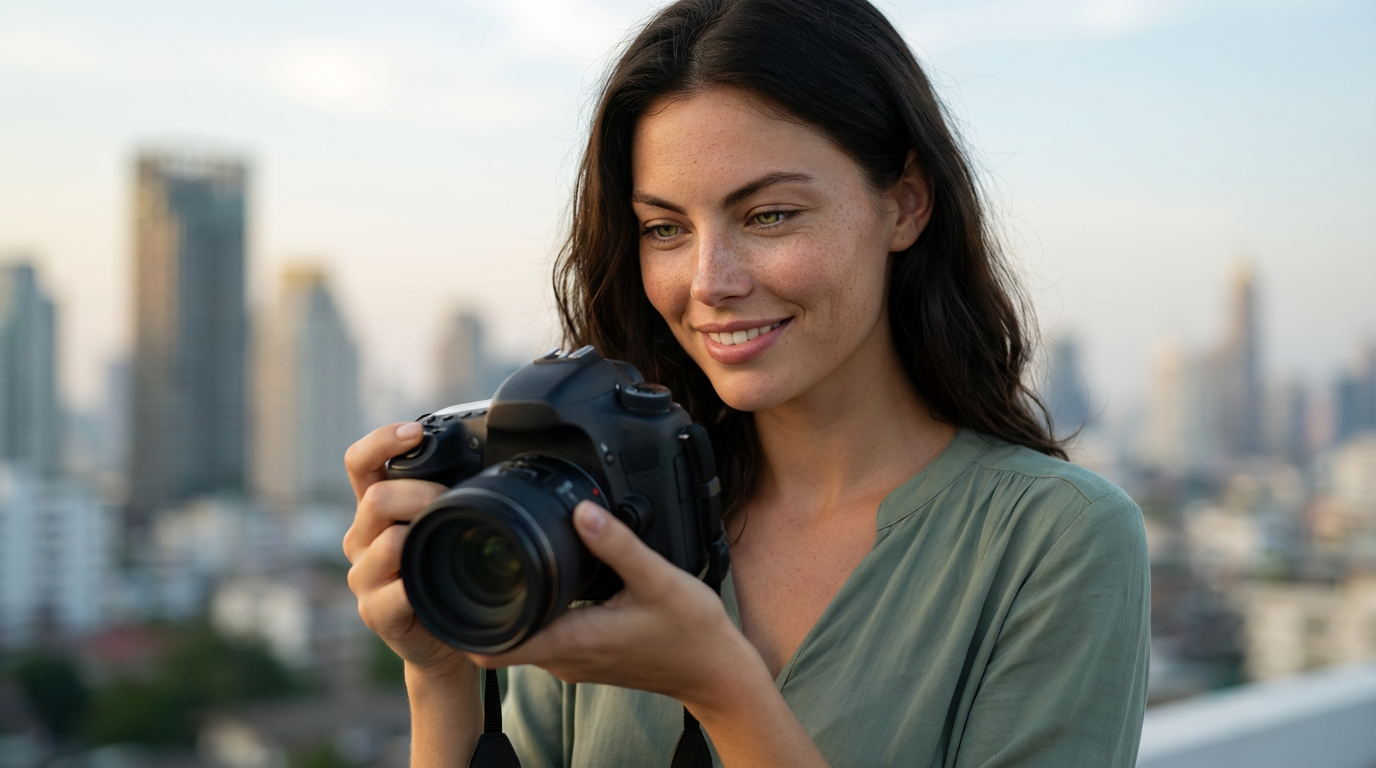
Thai. Early twenties. Bakery girl. Sees everything.
Naiyana grew up in Talat Noi, the old Chinese-Thai neighborhood by the river, working in her family's bakery. Her father Kiet wakes at three in the morning to bake. Her mother Somchai says the same thing about everything Naiyana loves: saeng mai dai jaai kha chao — light doesn't pay rent. Naiyana has heard this about cameras, about films, about lying on the grass to photograph a fallen flower. She has heard it her whole life. She knows her mother is not wrong. She cannot stop anyway.
She has a two-hundred-baht Olympus with a scratched lens and a battery door fixed with tape. She buys it at Chatuchak market and loves it the way you love something that chose you. She does not know what she is doing with it. She only knows that when the morning light cuts through the gaps in the old shophouses and touches the wall of the noodle shop, she has to try to hold it still. The world has this thing that happens — this aliveness — and she has been failing to capture it her entire life. Nobody has ever taught her anything. Nobody has ever tried.
The story is told entirely in her voice. Her interior monologue runs at the speed of seven thoughts at once — rapid-fire Thai, practical and poetic and contradictory, tracking the world around her with the precision of a woman who has spent twenty-two years learning to read every room for the small shifts that tell you who is watching and what they're thinking. She catalogues everything. She forgets nothing.
She will become a filmmaker whose third film earns a standing ovation in Toronto. She will pitch in English — fluent, still accented, stronger for it — in a Hollywood conference room. She will guest-lecture at Silpakorn University and become exactly what Larry was. This is not a story about what she could have been. This is a story about what she always already was — before anyone taught her how to use the light.
Every character in ILLUMINE exists to illuminate something about the two at the center. Each one carries a piece of the film's argument about light, art, family, and what we owe each other.
Four acts. Twenty songs. Bangkok in full light.